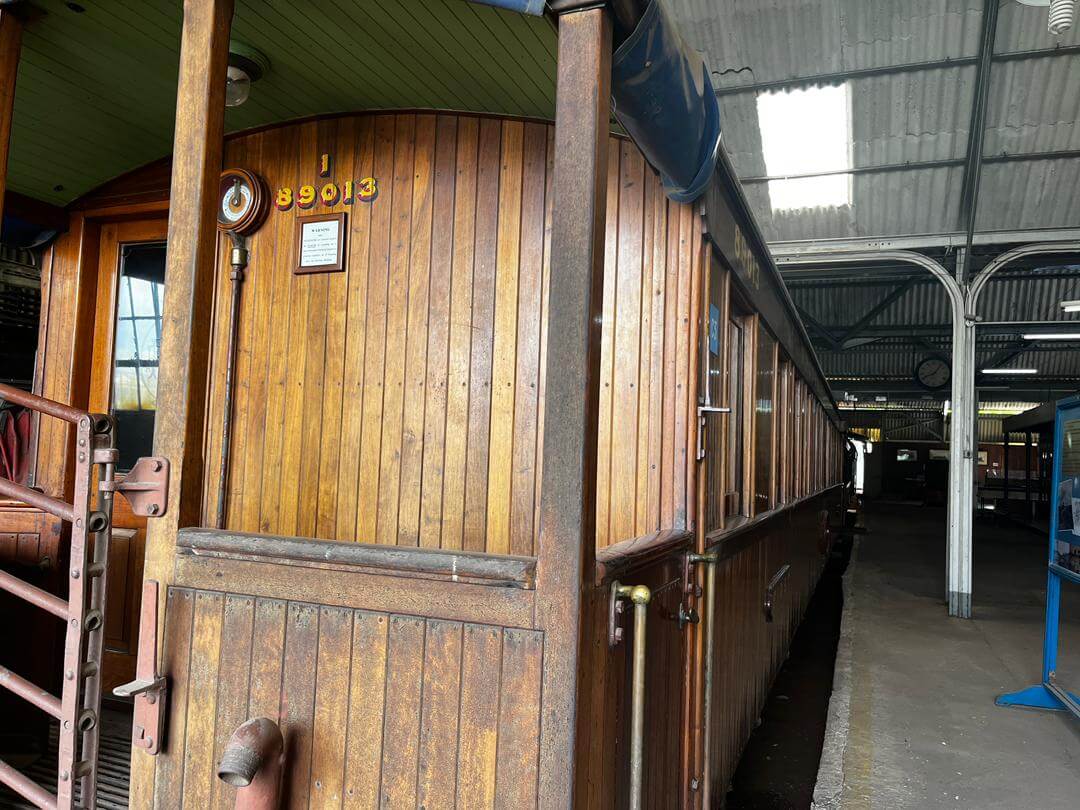
That was the year Rhodes died. And this coach — Car Number 1, built in Birmingham in 1897 for £3,200 — carried his body on the first leg of its journey to the Matopos Hills, where he had asked to be buried among the granite rocks he called the View of the World. The photograph taken at that burial on 10 April 1902 shows a crowd of several hundred people gathered on a bare granite dome 35 kilometres south of Bulawayo. Rhodes had chosen the spot himself years before his death. The train that brought him there still exists. It is parked in a quiet railway yard 400 metres from Bulawayo's main station, and you can step inside it today for $5 USD.
This article covers exactly what is inside the National Railways of Zimbabwe Museum — the Rhodes coach in full detail, the story of the men who drove the Beyer-Garratt locomotives for decades, the indoor photographic archive, and everything you need to plan your visit including opening times, fees, and directions from the city centre.
The Coach That Built and Buried an Empire
Rhodes had Car Number 1 built by the Metropolitan Railway Carriage and Wagon Company in Birmingham in 1897. The cost was £3,200 — roughly £450,000 in today's money. It was designed for a man who spent months at a time travelling through southern Africa and needed to work, sleep, and receive visitors while doing so.
The coach is 15 metres long, teak-panelled inside and out, and built on a 3ft 6in narrow-gauge undercarriage standard across southern Africa. Step inside and turn left. The sleeping compartment runs the length of that side — a fixed single berth with a horsehair mattress, a folding washstand in polished brass, a ventilation window angled to catch the breeze while keeping out the dust.
Turn right and you are in the sitting room. Two leather bench seats face each other. A fold-down writing desk sits beneath the window. In 1899 Rhodes held a meeting at that desk with Ndebele chiefs as part of negotiations following the Ndebele uprising. In 1900 he rode this same coach back from Beira, Portuguese East Africa, after being trapped in the Siege of Kimberley for four months.
On 26 March 1902 Rhodes died in a small cottage in Muizenberg, Cape Town. He was 48. His heart condition had been deteriorating for years. His body was transported by train from Cape Town to Bulawayo — a journey of over 2,700 kilometres — and Car Number 1 formed part of that funeral train for the final leg into Bulawayo.
From Bulawayo, Rhodes' coffin was carried by gun carriage to the Matopos Hills. The burial took place on 10 April 1902 on a granite dome Rhodes had called the View of the World — now officially known as World's View at Matobo National Park. Ndebele chiefs who had fought against Rhodes in the 1890s attended. They gave him the royal salute — Bayete — a recognition granted to very few outsiders in Ndebele history.
The coach was retired from service in 1920 and transferred to the museum collection in 1947. The leather on the bench seats is original. The brass fittings are original. Nobody replaced them because nobody needed to. Run your hand along the armrest. Nobody stops you.
How the Railway Built Zimbabwe
From the Rhodes coach, walk back toward the entrance of the yard and the scale of what came after him becomes immediately clear. The Kitson Class 7 locomotive sitting on the first track — built in Leeds in 1896, weighing 42 tonnes — was the kind of engine that opened this country. The 20th Class Beyer-Garratt at the far end of the yard, weighing 196 tonnes, was the kind of engine that ran it for the next 80 years.
The first railway track entered what is now Zimbabwe on 4 November 1897, crossing the Plumtree border from Bechuanaland. It reached Bulawayo 16 days later — 20 November 1897. Rhodes had pushed the line north from the Cape at extraordinary speed. The section through Zimbabwe was completed in stages: Bulawayo by 1897, the Victoria Falls bridge in 1905, the link to the Congo border by 1909.
The railway did not just connect places. It created them. Gweru, Kwekwe, Kadoma exist because a station was placed there first. Hwange's coal mines opened because the railway could carry the coal out. The tobacco industry that dominated Rhodesia's economy for most of the 20th century depended entirely on rail to move product from farm to port.
By 1950, Zimbabwe Railways was running 3,800 kilometres of track and employing over 20,000 people. According to the Zimbabwe Tourism Authority, the railway network remains one of the most historically significant infrastructure legacies of the colonial era in the region.
The Outdoor Locomotive Collection
The museum sits on an active section of the NRZ yard on Josiah Tongogara Street. The outdoor collection runs along three parallel tracks and contains 27 locomotives covering the period from 1896 to 1978.
The oldest piece is the Kitson Class 7 built in Leeds in 1896. It weighs 42 tonnes, runs on the standard 3ft 6in narrow-gauge track, and was one of the first engines to operate the Bulawayo to Mafeking run. At the other end of the yard, the 20th Class Beyer-Garratt — number 722 — sits on a raised section of track. The size difference between these two machines, standing 30 metres apart, is the entire story of Zimbabwe's industrial development in iron and steel.
The Beyer-Garratt Locomotives — And the Men Who Drove Them
The museum has five Garratt locomotives including a 20th Class and a 15th Class — the two types that carried Zimbabwe's heavy freight between the 1950s and 1980s.
The 20th Class was built by Beyer-Peacock in Manchester between 1954 and 1958. Zimbabwe Railways ordered 52 of them. Each one weighs 196 tonnes in working order, produces 3,500 horsepower, and could haul a 1,200-tonne coal train from Hwange to Bulawayo — 335 kilometres — without stopping for fuel.
The museum's 20th Class example, number 722, was withdrawn from service in 1984 after 28 years of operation. Its mileage log, mounted on a board beside the locomotive, records 2.3 million kilometres. That is 57 trips around the earth.
What the mileage log does not record is the names of the drivers. Locomotive 722 would have had a regular crew for most of its working life — a driver and a fireman working the Hwange to Bulawayo coal run, knowing every gradient, every water stop, every section of track that required careful handling. The NRZ employed thousands of Zimbabwean drivers and engineers from the 1950s onward, many of whom spent their entire working lives on a single route. The museum's indoor archive has photographs of some of them. They are worth finding.
The Garratt design solved a specific engineering problem. A single large locomotive would be too heavy for Zimbabwe's lighter track. The Garratt articulates across two separate bogies — two engine units sharing one boiler — distributing the weight while keeping the power. It became the dominant heavy freight locomotive across southern and east Africa for four decades.
The Indoor Exhibition
The main building houses uniforms, signalling equipment, original timetables from the 1920s through the 1970s, and an extensive photographic archive.
The 1905 photograph of the Victoria Falls bridge under construction — shot from the Zimbabwe side as the two cantilever arms reach toward each other 90 metres above the Zambezi — is worth the entry fee on its own. There are also 43 scale models of locomotives and rolling stock built by NRZ workshop craftsmen between 1960 and 1985. These were not made for tourists. They were made by engineers who loved what they worked on, and it shows in every rivet.
The most common question visitors ask at the gate is whether photography is included in the entry fee. It is — no extra charge. Bring your camera. The light in the outdoor yard is best between 8:00am and 10:00am before the Bulawayo sun moves directly overhead and kills the shadow detail on the locomotives.
Practical Tips
Address
National Railways of Zimbabwe Museum, Josiah Tongogara Street, Bulawayo — 400 metres west of Bulawayo Railway Station
Getting There
On foot from City Hall: 12-minute walk heading west on Leopold Takawira Avenue, turn left onto Josiah Tongogara Street
By taxi from Bulawayo city centre: under $2 USD
Self-drive parking available at the gate
Opening Hours
Monday to Friday: 8:00am — 5:00pm
Saturday: 8:00am — 1:00pm
Closed Sundays and public holidays
Call ahead to confirm: +263 (0)29 2363 411
Entry Fees (verify at gate — fees are updated periodically)
Zimbabwean citizens: $2 USD
SADC nationals: $3 USD
International visitors: $5 USD
Photography included — no extra charge
What to Bring
Closed shoes — the yard is gravel and uneven, sandals are uncomfortable
Minimum one litre of water per person — Bulawayo averages 32°C in October and there is no shade in the outdoor yard
Cash in USD — no card facility at the gate
How Long to Allow
Outdoor collection only: 45 minutes minimum
Full visit including indoor exhibition: 2 hours
Serious photography: arrive at 8:00am, allow 3 hours
Combine Your Visit With
Matobo National Park — 35 kilometres south of Bulawayo. Rhodes is buried here at World's View. The same hills he looked out at from his private coach, the same place the funeral train delivered him in April 1902
Natural History Museum of Zimbabwe — 900 metres from the NRZ Museum on Centenary Park. One of the finest natural history collections in Africa
Bulawayo Railway Station — 400 metres east. The 1909 building is a working station and one of the finest examples of colonial railway architecture in southern Africa. Trains to Victoria Falls depart from here three times a week
The Train Is Still There. So Is the Grave.
Most of what Rhodes built has been renamed, repurposed or demolished. The coach is still there. The locomotives that ran his railway are still there. And the grave in the Matopos is still there, 35 kilometres south, on the same granite dome he used to ride toward in this very carriage.
If you are visiting the museum today and driving to the Matopos tomorrow, the two experiences belong together. The coach shows you the man at the height of his power. The grave in the hills shows you where it all ended. Read our guide to World's View and the Matobo Hills before you make the drive — standing at that burial site makes considerably more sense when you have already sat in the chair he died travelling toward.